


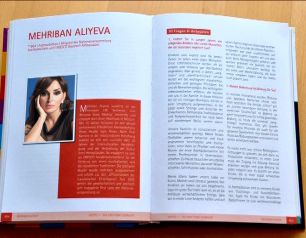
The interview by President of the Heydar Aliyev Foundation Mehriban Aliyeva was presented in the book ‘Women's Leadership - Power of women. Learning from the world's most successful women’ published in Germany
Germany’s influential "Hanseatic Lichthouse" Publishing House has recently published a ‘Women's Leadership – Power of women. Learning from the world's most successful women’ book by Director of the Politics and Public International Institute Kerstin Pleven. The book includes interviews and articles of world's 60 most successful, influential and well-known women from 30 countries.
An interview of Azerbaijan’s First Lady, Goodwill Ambassador of UNESCO and ISESCO, MP, President of Heydar Aliyev Foundation Mrs. Mehriban Aliyeva has also been published in the book. The publication is aimed to learn secrets of the women who achieved success in personal and social activities, as well as cover their valuable advice in connection with their public activity. The book also includes interviews and articles about other public figures such as German Chancellor Angela Merkel, US Secretary of State Hillary Rodham Clinton, UNESCO Director-General Irina Bokova and others.
Mrs. Aliyeva’s interview informs about significant projects realized by the Heydar Aliyev Foundation, which she heads, and the role of Azerbaijani women in the country's socio-political and cultural life, as well as about the fact that Azerbaijan was one of the first countries in the world to give voting right to women and other topics. Speaking about the Armenian-Azerbaijani, Daghlig Garabagh conflict, the First Lady of Azerbaijan underscored the problems of refugees and IDPs. Emphasizing that Azerbaijan pays a great importance to the education of women, M.Aliyeva said the number of women working in the governmental organizations, scientific institutions and private sector gradually increases in the country. Mehriban Aliyeva stated that the Azerbaijani women historically took an active part in the public life. The prominent Azerbaijani women such as Khurshudbanu Natavan and Mahsati Ganjavi have hugely contributed to the cultural heritage of the Azerbaijani nation, she said. Mrs. Aliyeva brought an interesting fact to the attention of the world community, saying that a water supply system was established in Shusha for the first time in the mid-19th century thanks to charity activities of Khurshudbanu Natavan, who was a well-known public figure and poetess. She said the system functioned until the beginning of the 1990s and was destroyed during the Armenian occupation.
The international community showed great interest in Mrs. Mehriban Aliyeva’s interview.